


 Look, I've been selling homes in Bloomington-Normal for over 14 years, and the question I get asked most often after "What's my home worth?" is "What will my property taxes be?" Well, thanks to some recent digging by The Pantagraph's Bill Flick, we now know exactly which homes in our area are paying the absolute highest property tax bills — and the numbers might surprise you.
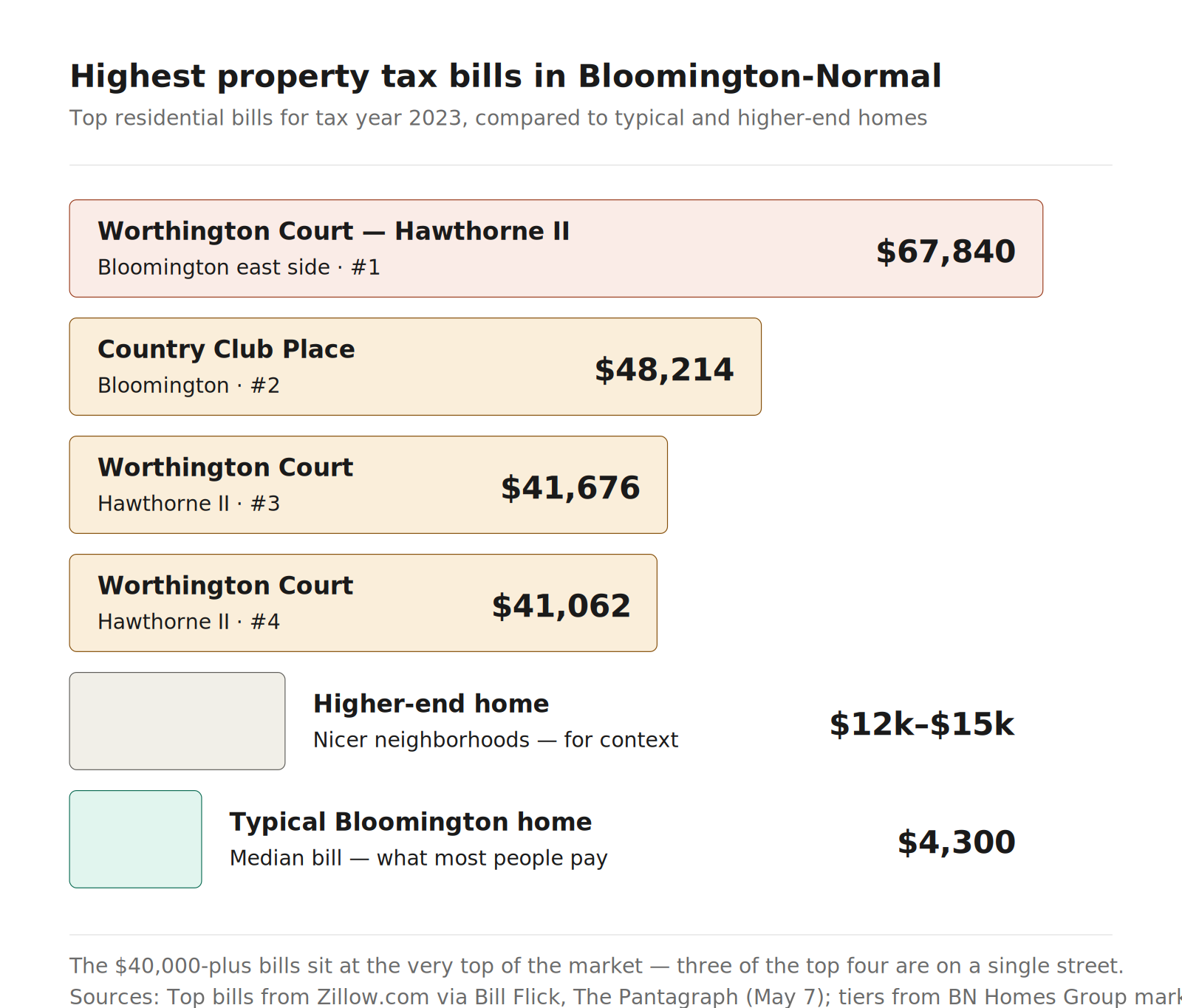
According to data from Zillow.com that Flick reported on May 7th, a home on Worthington Court in the Hawthorne II subdivision on Bloomington's east side topped the charts with a staggering $67,840 property tax bill for tax year 2023. Let me put that in perspective: that's more than many families in BloNo make in an entire year, and it's just for property taxes. It's also roughly 16 times what a typical Bloomington homeowner pays.
The Top Property Tax Bills in Bloomington-Normal
The numbers tell a fascinating story about where the most expensive properties in our Twin Cities are located. After that record-breaking Worthington Court home, the second-highest bill belonged to a property on Country Club Place in Bloomington, which paid $48,214 in 2023. Rounding out the top tier were two other homes on Worthington Court, with bills of $41,676 and $41,062 respectively.
What strikes me about this data is how concentrated these high-tax properties are. Three of the top four bills sit on a single street. Worthington Court clearly has some of the most valuable real estate in all of McLean County, and when you drive through that area, it's easy to see why. These are substantial homes in a well-established neighborhood that's become synonymous with luxury living in Bloomington.
The Hawthorne II subdivision has long been one of our area's premier addresses, and these tax bills reflect that status. When you're looking at homes in this price range, you're typically dealing with properties that offer everything from custom architecture to premium lot sizes, often backing up to green space or featuring other desirable amenities.
Putting the Numbers in Real BloNo Context
Here's where I think it's important to add some honest local perspective, because headlines like "$67,840 tax bill" can make people think that's what they're walking into when they shop for a nice home in Bloomington-Normal. It absolutely is not.
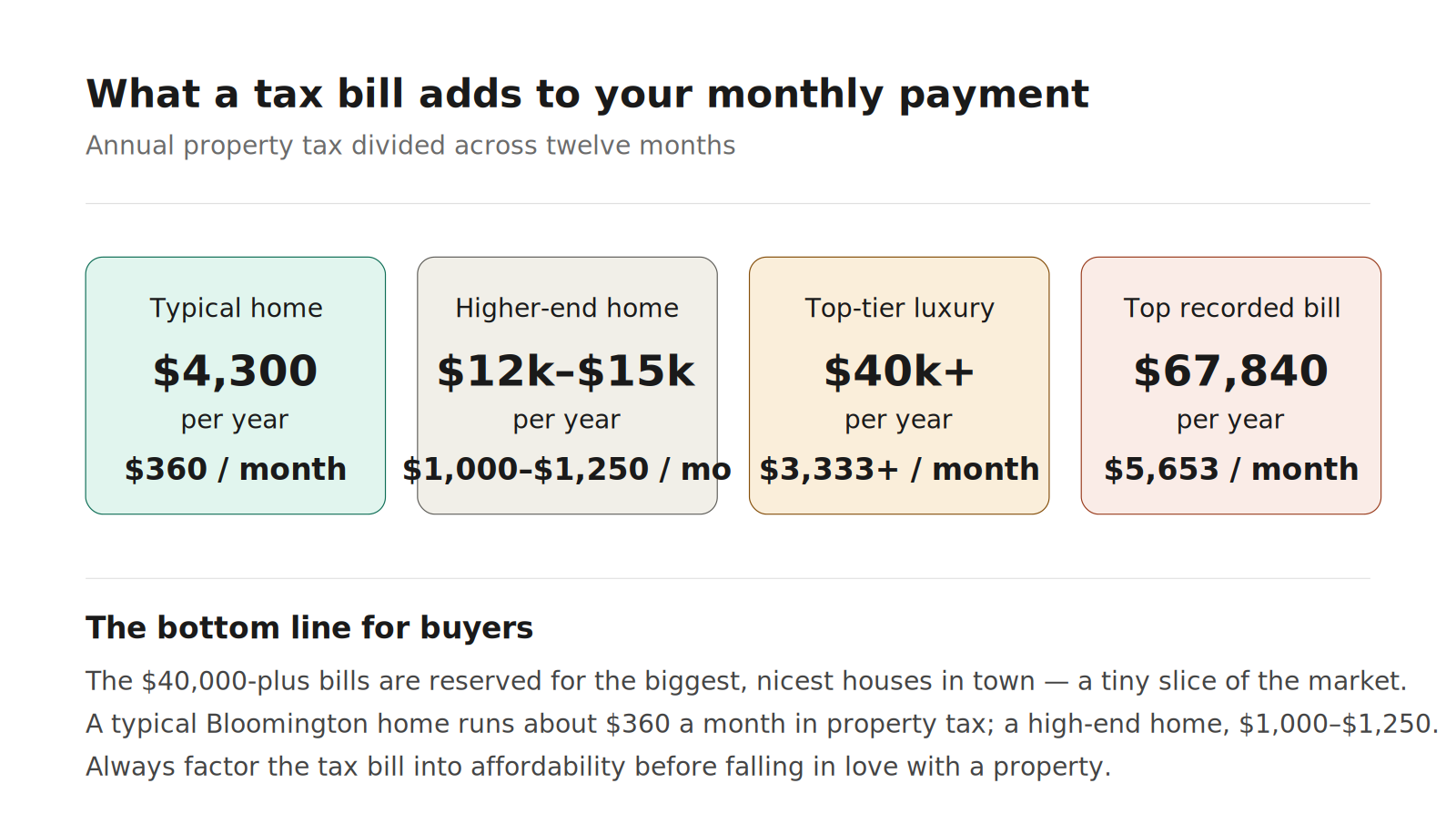
In reality, a typical Bloomington homeowner pays about $4,300 a year in property tax — roughly $360 a month. That's the bill on the kind of three-bedroom, two-bath family home that makes up the bulk of our local market. Step up into a higher-end home in one of our nicer neighborhoods, and you're typically looking at $12,000 to $15,000 a year, or about $1,000 to $1,250 a month. That's the range most of my buyers shopping in the $400K to $600K bracket will actually see on their tax bill.
The $40,000-plus tax bills you read about in The Pantagraph? Those are reserved for the very top sliver of the market — the biggest, nicest houses in town, the kind of trophy properties that change hands once a decade. Most buyers will never walk through one, let alone own one. So while it's fun to gawk at those numbers, they're not the benchmark you should be using to plan your own move.
What These Numbers Mean for Homebuyers
Here's what I tell my clients when we're looking at homes in any neighborhood: property taxes aren't just a number on a bill — they're a reflection of your home's value and the services your community provides. The bills you see in Hawthorne II, on Country Club Place, and across our higher-end neighborhoods are supporting excellent schools, well-maintained infrastructure, and the kind of municipal services that help maintain property values over time.
But let's be practical about it. Property taxes can vary dramatically from one neighborhood to the next, and sometimes even from one street to the next inside the same subdivision. I've seen homes a few blocks apart with bills that differ by thousands of dollars a year — same school district, same general feel, very different tax pictures. That's where having someone who actually knows the local market makes a real difference.
The reality is that Bloomington-Normal offers incredible diversity in housing options and tax burdens. Whether your comfort zone is the $360-a-month typical bill, the $1,000-a-month higher-end range, or something in between, there's a neighborhood here that fits. It all comes down to matching the right area to your budget and lifestyle — and going in with eyes open about the full cost of ownership.
The Bigger Picture for BloNo Real Estate
These high-end property tax bills actually tell us something positive about our local real estate market. They indicate that we have properties valuable enough to generate these assessments, which speaks to the desirability of certain Bloomington-Normal neighborhoods. Areas like the east side of Bloomington, parts of Normal near ISU, and established subdivisions throughout McLean County continue to attract buyers who are willing to pay premium prices for premium locations.
From my perspective, having sold homes throughout BloNo for years, I see these numbers as a reminder of why it's so important to work with someone who understands the local market inside and out. I can tell you which streets typically land at $4,000 versus which land at $14,000, often within the same subdivision. Knowing those details before you write an offer can save buyers from sticker shock down the road or help sellers price their homes appropriately.
Whether you're looking at a starter home near ISU, a family-friendly place in one of Normal's growing subdivisions, or a luxury property in an established neighborhood like Hawthorne II, understanding the full cost of ownership — including property taxes — is crucial to making the right decision.
If you're thinking about buying or selling in Bloomington-Normal, let's talk about what these property tax realities mean for your specific situation. Every neighborhood has its own character and cost structure, and I can help you navigate both to find the perfect fit for your budget and lifestyle.